
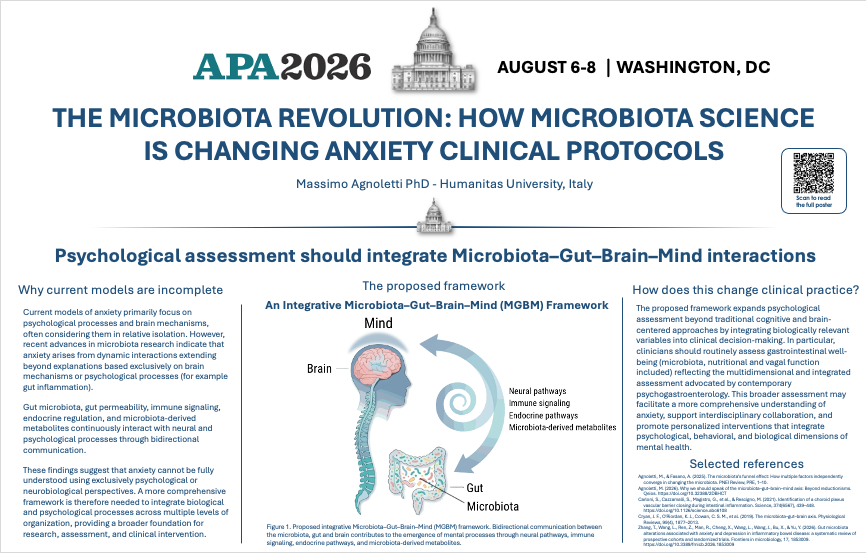
THE MICROBIOTA REVOLUTION: HOW MICROBIOTA SCIENCE IS CHANGING ANXIETY CLINICAL PROTOCOLS
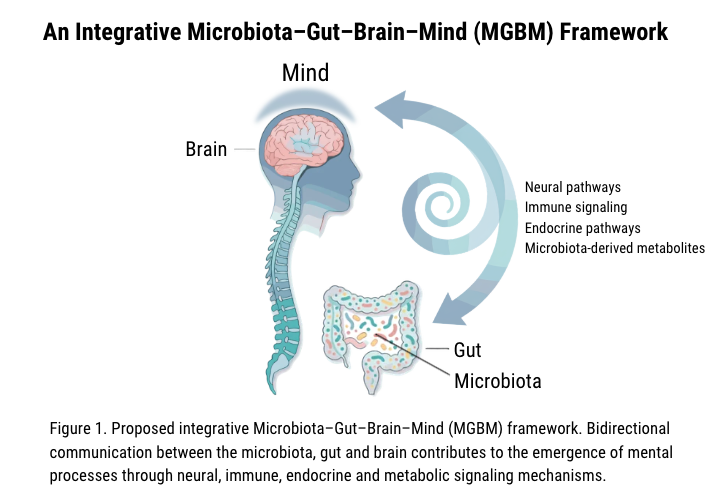
An Integrative Microbiota–Gut–Brain–Mind (MGBM) Framework
Presented at the APA
American Psychological Association
Annual Convention 2026, Washington DC (USA)

Massimo Agnoletti, PhD
Psychologist • Researcher • Lecturer
Humanitas University, Italy
Key Message
For decades anxiety has been conceptualized primarily as a disorder emerging from psychological and brain processes.
Recent discoveries in microbiota science suggest a broader perspective.
Gut microbiota, intestinal permeability, immune activation, endocrine regulation and vagal pathways continuously interact with brain function and psychological experience.
This does not replace psychology.
Rather, it expands psychological assessment by integrating biologically meaningful variables that may influence emotional regulation.
The proposed Microbiota–Gut–Brain–Mind framework offers an integrative perspective that may improve interdisciplinary collaboration, stimulate new research questions, and support more personalized psychological interventions.
Clinical implications for psychologist
1. Expand psychological assessment through biologically informed clinical decision-making
Psychological assessment should extend beyond cognitive, emotional, and behavioral dimensions to include clinically relevant biological factors, such as gastrointestinal symptoms, inflammatory biomarkers, gut barrier integrity, vagal function, and microbiota-related findings. Integrating these variables into case formulation may support more personalized, precise, and interdisciplinary psychological care.
2. Recognize bidirectional microbiota–gut–brain–mind interactions
Anxiety should be understood as the result of dynamic, bidirectional interactions between psychological processes and biological systems, rather than being explained exclusively by cognitive or brain-centered mechanisms. This integrative perspective provides a broader framework for understanding individual differences and informing clinical decision-making.
Concluding Perspective
The future of psychological assessment is not less psychological—it is more integrative. Incorporating microbiota–gut–brain–mind interactions into clinical reasoning does not replace established psychological models; it expands them by acknowledging the biological systems through which psychological processes are embodied, expressed, and potentially modified.
This perspective is consistent with the proposed Microbiota–Gut–Brain–Mind framework, whose goal is not to replace psychology with biology, but to broaden psychological science by integrating evidence from neuroscience, psychogastroenterology, immunology, and microbiota research into a unified clinical framework.
Thank you for your interest in this work. This page provides the poster, supporting publications, and additional resources related to the proposed Microbiota–Gut–Brain–Mind (MGBM) Framework.
CONTACT INFORMATION
 Mi chiamo Massimo Agnoletti, sono uno psicologo, un dottore di ricerca e uno specialista dello stress. Ho un'esperienza professionale internazionale, soprattutto negli USA, e da sempre ho la passione di studiare la psicologia scientifica per tradurla in modalità concrete ed applicabili al fine di migliorare il benessere delle persone.